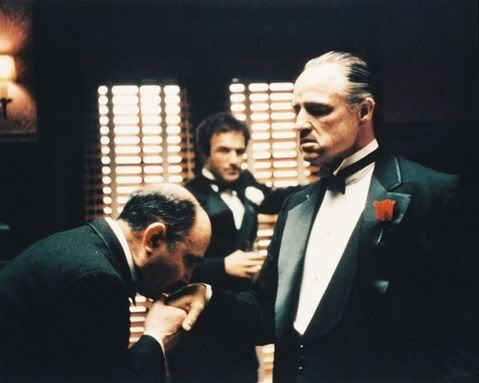
"And in the end, all that remains is our friendship." So says consoliere Tom Hagan as he reassures a bewildered US Senator that the murdered prositute in the Senator's bed would "disappear. . . as if she never even existed" in in the cinema classic Godfather II.
I thought about the Godfather movies while reading the latest research on customer gratitude and it's effects on business relationships. After all, nearly all of Vito Corleone's business was based on gratitude--doing favors for people who would not only repay the favor but also spread word of The Don's generosity and. . . um. . . capabilities. Prostitutes, horse heads and the like notwidthstanding, it's the model most businesses--especially service businesses--use.
First authored by Robert Palmatier of University of Washington with an assist from others including consumer behavior guru Frank Kardes, the article examines how feelings of gratitude strengthen business relationships as well as the key components to engendering that feeling within customers. They performed a big market survey plus extensive experiments with a large number of subjects. Here's what they found:
Four Factors in Creating Gratitude with Customers/Prospects
1. Doing something that is perceived as being of your own freewill--not something either contractually required or perceived to be "part of the deal." Those of you who have read the negotiating bible "Getting To Yes" will recognize this, where they advise you to "throw something in at the end" to make the customer feel like they have won something. So, even if the customer was already going to get the "Hannah Montana Back-To-School Commemorative Place Mats", make it seem like a spontaneous act of generosity.
2. Perceived Motives: The customer must perceive your motive as being earnest--or at the very least not malevolent. This is a hard one to break down, but I would liken it two very different experiences getting your car serviced. When you get your oil changed and the Jiffy Lube guy says "Would you come out here for a moment?", you prepare yourself for the shakedown ($3,000 tune-up) that is about to happen--you knew it was going to happen, but you still walk away from the experience thinking less of the Jiffy Lube and the guy. Conversely, if you hear a knock in your engine and the mechanic tells you, "We can completely fix it for $1,500 or do a six month band-aid for $200" you are likely going to tell all your friends to come to this mechanic because you do not question his motives.
3. Risk Undertaken By Seller: Without exception, doctors, lawyers, consultants and brokers have nightmare stories about prospects who sap every fiber of their being trying to get free services and advice. While those people represent A Bottomless Hole of Time, Money & Energy (aholes, for short), spending time off the clock with a prospect or customer is builds gratitude and trust. The trick is distinguishing the aholes from the prospects with potential to protect your own resources and sanity.
4. Meeting "The Customer's Perceived Need For the Received Benefit": The quotes represent the authors words. I would merely call it thoughfulness. If you take the time to really consider your client's needs and help, research showed it made a big difference. For instance, if you receive a holiday business gift of, say, Godiva Chocolates, you might very well think, "Nice chocolates--either all the other clients got this or this is a re-gift." However, if your contracts attorney calls you out of the blue and says, "I remember you mentioned a problem with your property taxes, so I asked a buddy of mine who is a real estate attorney and he said..." That's big and, more importantly, it provides value to the client's specific situation.
Lastly, the authors conducted a large survey to see what effect gratitude had on relationships and purchasing intentions and the effect was hugely significant. In short, for a customer, gratitude and the trust & obligations it generates, an offer they can't refuse.
Showing posts with label academia. Show all posts
Tuesday, November 17, 2009
Monday, November 2, 2009
Freezing and Starving: The Pioneer Experience
--Will Ferrell in Talladega Nights
The experience of being either an entrepreneur or a product manager is emotionally wrenching. You are awash in uncertainty and feel the crush of expectations. When launching a business or introducing a product, despite whatever research, analysis or reports, the entire endeavor hinges on a belief--a belief in yourself, your product and/or your judgement. Nothing is for certain until the product hits the shelves or the business opens its doors.
To minimize the uncertainty, many cling to trying to be the first to pioneer a product, service or idea. And, over the years, there has been a lot of research by some very smart people saying that being first makes all the difference. In fact, some of these very smart people have even said that they could not find any instances of pioneers that have failed.
There is some wonderful research by the very talented tandem of NYU's Peter Golder and USC's Gerard Tellis on new product introductions that shows that the "pioneer" advantage is overblown at best. Specifically, they say that the race does not go to the swift--the pioneers--but instead to "early entrants" who aren't the first to market, but rather, the first to get it right. And in their extensive analysis of companies from the late 19th century forward, it turns out that pioneers failed at about the same rate as other businesses while early entrants have a lower failure rate and a much higher instance of market leadership.
So, what determines, "getting it right"? The criteria identified by Golder & Tellis include:
- a vision of the mass market
- managerial persistence
- financial commitment
- relentless innovation
- asset leverage
So, while Ampex had a great vision for the technology, their vision for the market? Eh, not so much.
Managerial Persistence & Financial Commitment: This is probably the most difficult aspect of success. New products often take several years--in some cases a generation--to become mainstream. And in the meantime, stake holders in that product have to be convinced to stay the course. This is no small task when shareholders, financiers and leadership are demanding compelling returns and you have to stake your job and reputation on asking them to wait to see the fruits of their investment. Further complicating the analysis is that companies often have a bad strategy or product and in those instances, the right decision is to pull the plug.
Golder & Tellis offer a few examples of companies jumping ship too early, including Rheingold Brewery which introduced the concept of light beer in 1967. In the face of sluggish sales, Rheingold not only abandoned the light beer product, they fired the managers who had championed the concept. Lite Beer from Miller was introduced eight years later, advertised heavily and has been wildly successful ever since.
With business, as with any of life's greatest endeavors, there comes a gut check--a point where trust and commitment are all you have. And at that time, if you believe in what you are doing, you must press forward and accept risk and uncertainty. As Golder & Tellis point out, the great companies are the ones that can do this.
Relentless Innovation: One of the hardest things to do in business is to knowingly cannabilize your own revenue. But, it is always better to eat your own lunch, than have someone else eat it for you. They point to Gillette's cannibalization of their razor businesses over the years in order to renew its market leadership. I like to also point to The Dayton Company--an owner of department stores--which saw that traditional department stores were giving way to large scale discounters, so they founded one of their own, called Target.
Asset Leverage: What Golder & Tellis call "Asset Leverage", I might call "dropping the hammer." It's using your most compelling tools to the utmost. Large, successful companies have tremendous assets at their disposal--brand recognition, complementary products, financial resources, distribution networks and more. And in enterring a market, these companies can utilize those assets in a forceful way. There are a large number examples of this we can all cite. Golder & Tellis reference "Diet Coke" crushing the pioneer in diet sodas, Royal Crown. (My favorite is Microsoft's Internet Explorer, though their asset leverage aroused the interest of regulators worldwide.)
Given all of these examples, Golder & Tellis would seem like they are saying that an untried trail is a fool's path. Not so. They are merely saying that it's better to do it best, than to do it first.
They did a couple of articles on this topic, one in the Journal of Marketing Research, which is more technical and theoretically oriented, and the other in MIT's Sloan Management Review (article found here, subscription required). I would highly recommend that any entrepreneur or manager read the Sloan article. It is well researched, powerfully written and reads like a strategic manifesto. Perhaps most importantly, it gives perspective on the patience, hard work and (to quote the professional wrestler Gorilla Monsoon) "intestinal fortitude" it takes perservere in the market.
Subscribe to:
Posts (Atom)