Showing posts with label strategy. Show all posts

Monday, November 23, 2009

When do Chief Marketing Officers Matter? -- A Marketing Manifesto

The plight of marketers from a political and organizational standpoint is significant and includes: 
  • Everyone in the organization thinks they are a marketer.
  • Few take marketing seriously or understand what it is--but are "pretty sure it consists of making catchy jingles."
  • Most organizations view marketing purely as an expense and when the going gets tough, apparently the tough start slashing marketing budget and laying off marketing staff before they touch anything else.
  • In smaller companies, marketing is held in such low esteem that marketing duties are often given to <>. . . secretaries who are told to "make a brochure. . . or something." 
And we marketers weather these indignities despite everyone being confonted with a constant tidal wave of evidence that marketing makes all the difference:
  1. The companies we admire most (Apple, Nike, Starbucks, etc.) are--without exception--monster marketers.
  2. Generally, the first thing we decry about companies we don't like--cigarette, alcohol, pharmaceutical companies and so on--is the fact that their marketing is so effective it appears to turn people into zombies walking the Earth in search of Camels Lights, Michelob and Viagra.
Well, the good people of marketing academia are trying to aid our plight. Dr. Eric Boyd has written a paper analyzing when Chief Marketing Officers make a difference which is slated to be published in the Journal of Marketing Research in 2010. The paper looked at, and found, the following:

1. The effectiveness of a CMO can be greatly diminished in the face of extraordinary customer power. Company sales are becoming more concentrated in a few large clients. With that comes a large influence of that customer over policy and a risk aversion that can hamstring the marketing function (as well as other functions). For instance, if WalMart accounts for 20% of your company's business, as nice as it would be to pull in a Target or Lowe's as client, Job #1 is going to be to keep WalMart happy. And that perspective can be suffocating to marketing and business development.


"So, CMO, what is it you would say that you do here. . . exactly?"

2. CMOs can provide the largest effect on firm value (for better or worse) if that executive is brought in from outside the firm, is given a broad mandate and has the seniority and experience to gain internal credibility. Some of this sounds like commonsense, but it really comes down to commitment. Many companies who do not have a history of marketing and then decide to hire a marketing "guru" often hamstring that professional through an aversion to change and risk. But, to hire a CMO and then not utilize that person's talents is like getting engaged with the idea that you can still date--it's not going to work and besides, what's the point? Organizations need to decide what they want to be and then own that decision. The firms studied that did this, on average, achieved a significant ROI for their marketing investment and a resulting increase in share price.
As we have seen in other articles, when it comes to business strategy & marketing, doing nothing is better than taking half-measures. If you are going to be a bear, be a grizzly. Don't get Fred the office manager to make a brochure in his spare time and pretend you are "ramping up" marketing. That's like asking Paris Hilton to fix your car or Terrell Owens to do your taxes. Activity does not equal results. Firms need to hire skilled professionals and then let them do their job, otherwise you are just wasting everyone's time, money and energy.

Tuesday, November 17, 2009

The Power of Gratitude


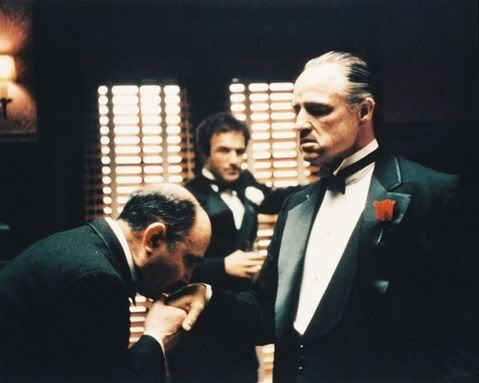
"And in the end, all that remains is our friendship." So says consoliere Tom Hagan as he reassures a bewildered US Senator that the murdered prositute in the Senator's bed would "disappear. . . as if she never even existed" in in the cinema classic Godfather II.

I thought about the Godfather movies while reading the latest research on customer gratitude and it's effects on business relationships. After all, nearly all of Vito Corleone's business was based on gratitude--doing favors for people who would not only repay the favor but also spread word of The Don's generosity and. . . um. . . capabilities. Prostitutes, horse heads and the like notwidthstanding, it's the model most businesses--especially service businesses--use.

First authored by Robert Palmatier of University of Washington with an assist from others including consumer behavior guru Frank Kardes, the article examines how feelings of gratitude strengthen business relationships as well as the key components to engendering that feeling within customers. They performed a big market survey plus extensive experiments with a large number of subjects. Here's what they found:

Four Factors in Creating Gratitude with Customers/Prospects
1. Doing something that is perceived as being of your own freewill--not something either contractually required or perceived to be "part of the deal." Those of you who have read the negotiating bible "Getting To Yes" will recognize this, where they advise you to "throw something in at the end" to make the customer feel like they have won something. So, even if the customer was already going to get the "Hannah Montana Back-To-School Commemorative Place Mats", make it seem like a spontaneous act of generosity.

2. Perceived Motives: The customer must perceive your motive as being earnest--or at the very least not malevolent. This is a hard one to break down, but I would liken it two very different experiences getting your car serviced. When you get your oil changed and the Jiffy Lube guy says "Would you come out here for a moment?", you prepare yourself for the shakedown ($3,000 tune-up) that is about to happen--you knew it was going to happen, but you still walk away from the experience thinking less of the Jiffy Lube and the guy. Conversely, if you hear a knock in your engine and the mechanic tells you, "We can completely fix it for $1,500 or do a six month band-aid for $200" you are likely going to tell all your friends to come to this mechanic because you do not question his motives.

3. Risk Undertaken By Seller: Without exception, doctors, lawyers, consultants and brokers have nightmare stories about prospects who sap every fiber of their being trying to get free services and advice. While those people represent A Bottomless Hole of Time, Money & Energy (aholes, for short), spending time off the clock with a prospect or customer is builds gratitude and trust. The trick is distinguishing the aholes from the prospects with potential to protect your own resources and sanity.

4. Meeting "The Customer's Perceived Need For the Received Benefit": The quotes represent the authors words. I would merely call it thoughfulness. If you take the time to really consider your client's needs and help, research showed it made a big difference. For instance, if you receive a holiday business gift of, say, Godiva Chocolates, you might very well think, "Nice chocolates--either all the other clients got this or this is a re-gift." However, if your contracts attorney calls you out of the blue and says, "I remember you mentioned a problem with your property taxes, so I asked a buddy of mine who is a real estate attorney and he said..." That's big and, more importantly, it provides value to the client's specific situation.

Lastly, the authors conducted a large survey to see what effect gratitude had on relationships and purchasing intentions and the effect was hugely significant. In short, for a customer, gratitude and the trust & obligations it generates, an offer they can't refuse.